


When ACorp founder Alexander Slade first experimented with Claude Code, he was surprised by how quickly he could turn ideas into working applications. Within a few weeks, he’d built 38 different portals addressing individual business problems.
But that initial burst of enthusiasm revealed an important lesson: just because you can build something doesn’t mean you should.
“I need to slow down and figure out what’s next and actually get some usefulness out of this,” Alex recalls.
Today, he is taking a more structured approach, assessing and developing internal tools that improve operations while helping SMB clients navigate their own AI journeys.

Start with problems, not possibilities
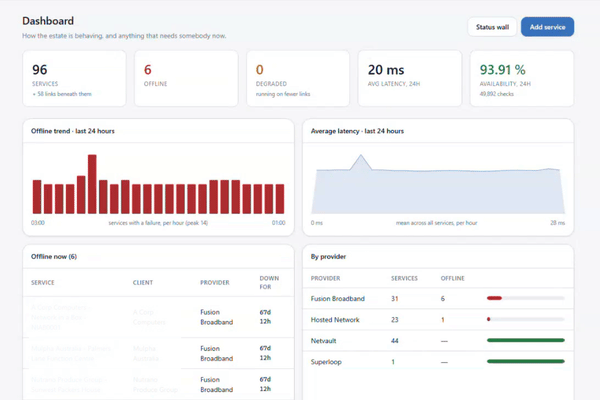
One of ACorp’s first practical developments was a network monitoring dashboard bringing together information from multiple wholesale internet providers.
Previously, technicians needed to check different systems to investigate connectivity problems. The new dashboard provides a consolidated view of connection status, trends and alerts as well as identifying the relevant supplier when a connection fails, adding useful context to support tickets.
Another success is ACorp’s custom compliance portal. Previously, the team managed SMB1001 compliance consulting through spreadsheets. The new system integrates with ConnectWise, tracks progress and evidence, and provides shared access for staff and customers.
Prioritising projects for AI development
With AI making development faster, ACorp’s challenge has shifted from what it can build to what deserves attention.
Rather than inviting an endless wish list from employees, Alex and a junior team member/BA identify opportunities, consult the team and consider their relevance across the business.
As a growing company with a recently formalised sale function, a current priority is improving the handover between sales and service delivery. Other projects, including security tooling improvements, have been paused.
One lesson learned is to focus on completing and handing over business solutions. With AI, finishing and deploying becomes the challenge as the ease and satisfaction of creation often makes it tempting to just keep building.
“In the end, I wasn't shipping anything. I wasn't actually sending it out publicly internally either. I was just using it and kept adding to it and building.”
Alexander Slade, acorp
Build, buy or rethink?
AI-assisted development is also changing acorp’s approach to software procurement.
Alex is considering a new client portal that could automate routine requests for licences, equipment and quotes. However, the existing quoting platform has a read-only API, limiting what can be automated.
This raises a familiar decision: replace the software, work around its limitations or develop an alternative.
The ability to build quickly doesn’t eliminate the need to consider integrations, ongoing maintenance and commercial value and there are no plans to start replacing core systems like RMM or PSA with self-developed alternatives.
Managing AI development risk
Rapid development also introduces key-person risk. What happens if the person who built an application leaves?
ACorp is adopting standard development practices, storing code in GitHub and using Claude to generate documentation. Importantly, other team members are brought into projects early so they understand the business requirements.
This helps ensure internally developed solutions remain supportable rather than becoming dependent on their creator.
Helping clients navigate AI
ACorp is applying these lessons to customer conversations, including through its upcoming AI Without the Hype business education event through their local Chamber of Commerce.
Alex encourages clients to understand how employees are already using AI before investing in additional tools.
For example, a customer considering Claude for everyone discovered that many employees were primarily using AI to write emails, meaning Microsoft Copilot could adequately meet those needs, with more specialised tools reserved for appropriate users.
ACorp is also developing its commercial approach, beginning with advisory and consulting work before potentially expanding into implementation and ongoing management of AI infrastructure, security and processes.
Alex sees this as a natural extension of the MSP relationship. Businesses may initially experiment independently, but eventually will need professional support and – in time – managed services ongoing.
“Just like we would manage a Windows Active Directory controller or a Microsoft Entra ID… now you're managing an MCP server for an organisation because it's going to have the same requirements.”
For smaller MSPs, ACorp’s experience offers a practical starting point: experiment internally, solve real business problems, build responsibly and use that experience to guide customers through AI adoption.
For Alex, the biggest lesson has been that AI’s potential isn’t simply about how quickly you can build something, but whether it solves a worthwhile problem and can be supported over time. By experimenting within Claude, he’s learning firsthand what works, what doesn’t and where the risks lie – knowledge he can take directly to his customers. As AI makes technology development more accessible to everyone, the opportunity for MSPs may be less about building everything themselves and more about helping businesses make smart decisions about what to build, what to buy and how to manage it.
Alex is also sharing his experiences through The AI Podcast, a new venture with fellow MSP Elliot Munro. Appropriately enough, they’re using AI to help produce the podcast itself, from editing recordings to creating social media content!